
Wordle Strategy Guide: How to Solve in 3 to 4 Guesses
March 18, 2026
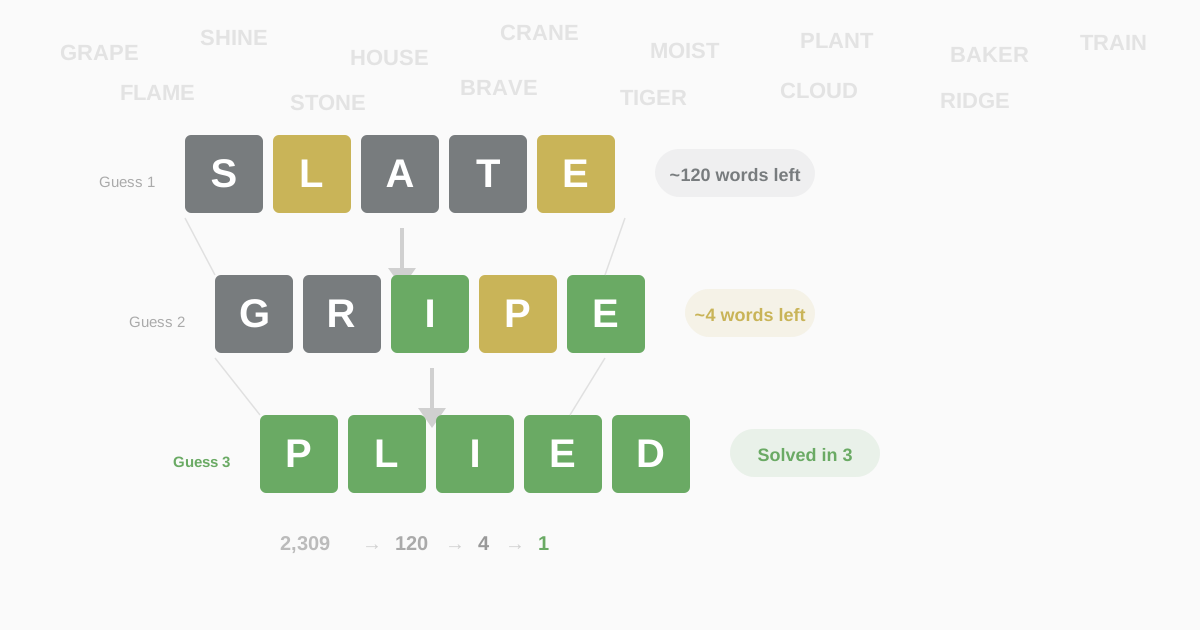
A practical Wordle strategy for using each tile, spotting repeated letters, avoiding word-family traps, and solving more often in three or four guesses.
Table of Contents
The Goal: Consistent Solves in 3 to 4 Guesses
A lucky three is satisfying, but a repeatable three or four comes from reading the board well. The aim is not to force every puzzle into three rows. It is to avoid guesses that tell you almost nothing.
Shared result data usually places the average solve near four attempts. The exact figure moves from day to day because some answers create far more look-alikes than others. Instead of chasing a fixed score, ask a smaller question before each row: what will this word teach me if the tiles come back grey?
That question keeps the game practical. A useful guess either tests several untried letters, places known yellow letters in new spots, or separates a group of plausible answers. A weak guess repeats information you already have. The sections below follow that process from the opener through the common late-game traps.
Guess 1: Maximize Information with a Strong Opener
Treat the opener as a scout. Solving immediately is a pleasant accident; on most days, the first row is there to expose useful letters. Five different, common letters give the board more chances to answer you.
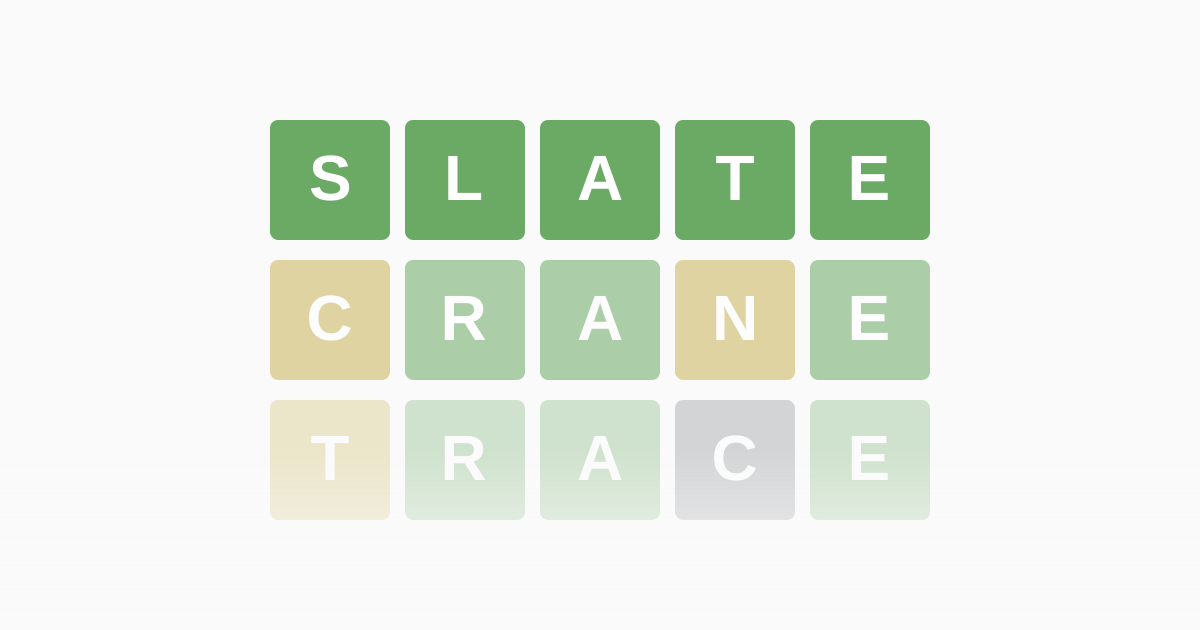
SLATE, CRANE, TRACE, and STARE all do that job without reaching for strange dictionary words. Each combines two vowels with three common consonants and avoids duplicate letters. The Best Starting Words guide compares them in detail, but the tiny differences between strong openers matter less than using the result properly.
There is no need to change a good opening word every morning. Familiarity can help: after using the same opener for a while, you learn which second guesses work when only A is yellow, when S turns green, or when the entire row is grey.
Guess 2: Use Tile Feedback Strategically
Row two should respond to row one. Keep green letters fixed. Move every yellow letter to a position it has not already failed in. Leave grey letters behind unless a duplicate in the first guess makes the result ambiguous.
Imagine SLATE returns a yellow A while S, L, T, and E are grey. The second guess must contain A somewhere other than the third square, but its other four spaces are free. That is a good moment to test common untouched consonants such as R, N, C, and D rather than recycling letters the board has rejected.
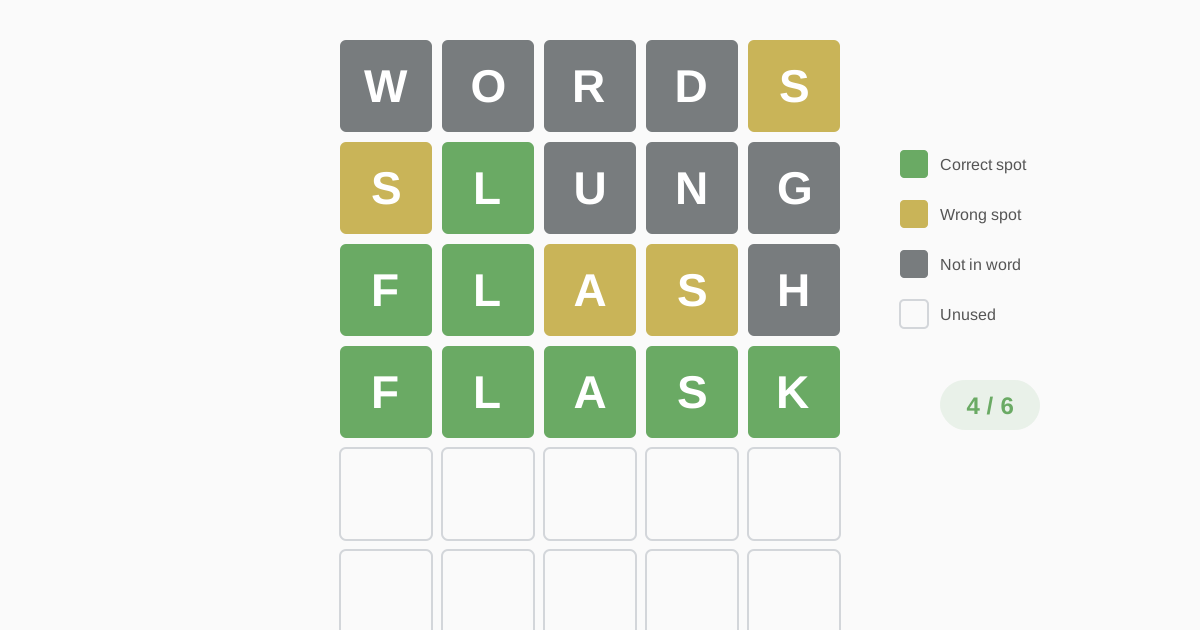
When the opener gives two or three coloured tiles, do not automatically hunt for the answer. First count the plausible word family. If many words fit, choose a guess that separates them; if only one or two fit, solving directly makes sense. The How to Play Wordle guide has a slower explanation of the colour rules.
Guess 3 and Beyond: Narrowing Down Candidates
If your first two guesses were well chosen, the candidate pool is typically under 20 words by guess three. This is where the puzzle shifts from broad elimination to targeted narrowing.
Start thinking in word patterns. If you know A is in position 2 and E in position 5, run through _A__E candidates mentally: BADGE, BARGE, DANCE, LANCE, LARGE, SAUCE. Then cross-reference against your grey and yellow data to eliminate options that contradict what you already know.
When several candidates remain and you cannot tell them apart, consider a diagnostic guess, a word chosen specifically to differentiate possibilities rather than to solve the puzzle. If your remaining candidates are BARGE, BADGE, and LANCE, guessing a word like BLIND tests B, L, N, and D in one move, which can confirm or eliminate multiple options at once.
Diagnostic guesses are most valuable on guess three, when you still have attempts to spare. By guess five or six, the math shifts toward picking a remaining candidate and hoping it lands.
Common Letter Patterns in English
Recognizing five-letter word structures helps you narrow down candidates faster, sometimes saving an entire guess.
The -IGHT family (LIGHT, MIGHT, NIGHT, RIGHT, SIGHT, TIGHT) is one of the most common. When you see _IGH_, the answer almost always ends in T. Spotting that pattern early collapses the problem down to identifying the first letter.
The -OUND family (BOUND, FOUND, HOUND, MOUND, POUND, ROUND, SOUND, WOUND) works similarly. Identifying O-U-N-D early points straight to this group.
The -ATCH family (BATCH, CATCH, HATCH, LATCH, MATCH, PATCH, WATCH) is another frequent one. Confirm A in position 2 and T-C-H in positions 3 through 5, and the puzzle becomes a single-letter problem.
Other patterns worth keeping in your mental library: -ANCE and -ENCE endings, -ASTE, -LING, and common starting pairs like SH-, CH-, TH-, ST-, and CR-. Building familiarity with these structures cuts guesses because you can leap to a family of words instead of building them letter by letter.
Handling Double Letters
Roughly 15% of Wordle answers contain a repeated letter (think SPEED, LEVER, VIVID). The feedback rules for doubles are specific and worth understanding.
If the answer has two of the same letter and you guess one instance of it, the tile shows green or yellow normally. It does not signal whether the letter appears once or twice. You will not know about the double from a single instance.
If you guess two of the same letter and the answer only has one, one tile gets colored and the other turns grey. That grey tile is telling you the letter appears exactly once, which is valuable information.
The practical advice: avoid double-letter words in your first two guesses. Early attempts should test as many unique letters as possible. If by guess three your feedback suggests a double (say, a yellow E from one guess and a green E from another), that is the time to start testing double-letter candidates.
The most common doubles in Wordle answers are LL (SKILL, DWELL), EE (CREEK, GREED), OO (DROOL, BROOD), and TT (WITTY, LATTE).
Hard Mode vs. Normal Mode Strategy
Normal mode lets you guess any valid word at any time. Hard mode requires all confirmed letters, green and yellow, to appear in every subsequent guess, with green letters locked in position.
That one constraint changes the game significantly. Normal mode allows diagnostic guesses: you can play a word that cannot possibly be the answer, purely to test suspected letters and narrow the field. Hard mode removes that option.
Two consequences follow. First, you have to be deliberate about where you place yellow letters, since they are required in every future guess. Second, guess traps become a real risk. A trap happens when your confirmed letters fit many valid words. The pattern _OUND, for example, matches BOUND, FOUND, HOUND, MOUND, POUND, ROUND, SOUND, and WOUND. In hard mode, you are stuck guessing from within that template, which can burn through attempts without progress.
The way to mitigate traps is to confirm distinguishing letters as early as possible, before the trap locks in. Hard mode is not harder for every puzzle, but the difficulty spikes sharply on patterns with many valid answers. For which openers perform best in hard mode, see the Best Starting Words guide.
Mental Models: Think in Positions, Not Letters
A common mistake is treating Wordle as five letters to identify. A better mental model is five positions to fill.
After each guess, update your mental map of each position individually. Position 1 might have three possible letters. Position 3 might be confirmed. Position 5 might be narrowed to two vowels. Tracking positions separately reveals the answer faster than trying to assemble letters into words, because it helps you notice when a position is nearly solved even if you have not identified the full word yet.
This model also makes yellow tiles more useful. A yellow in position 2 does two things: it eliminates that spot for the letter, and it tells you the letter belongs in positions 1, 3, 4, or 5. Combined with what you know about which letters are common in each position, you can make informed guesses about placement rather than guessing randomly.
Common Mistakes to Avoid
Reusing grey letters wastes a slot. Once a letter turns grey, it is not in the answer. Every time you include it in a future guess, that position could have tested something new.
Ignoring yellow tile positions is equally costly. Yellow means the letter is in the answer but not in the guessed spot. Both pieces of information matter. Players sometimes place a yellow letter in the same wrong position across multiple guesses, which wastes attempts and gains nothing.
Guessing obscure words early sacrifices diagnostic power. Words like NYMPH or GLYPH test rare letters that appear in very few answers. Save those for later rounds, when your feedback points toward uncommon letters.
Playing on autopilot after grey streaks leads to wild guesses. When your first guess comes back all grey, it can be tempting to try something exotic. The better approach is to stick to the method: test the highest-frequency remaining letters, respect all known data, and trust the process.
Overlooking common patterns costs guesses. If you have confirmed _I_HT, the answer is almost certainly in the -IGHT family. Pattern recognition saves an attempt that would otherwise go toward confirming what you could have deduced.
Frequently Asked Questions
About 3.9 guesses based on millions of shared results. Players who use a consistent opener and structured elimination typically average between 3.4 and 3.6.
Eliminate first. A correct first guess has about 0.04% odds. Spending two guesses on high-frequency letter coverage shrinks the pool enough for an accurate third or fourth attempt.
Hard mode builds stronger positional thinking and forces you to use feedback more carefully. The tradeoff is increased risk of guess traps on patterns like -OUND or -IGHT, where many words fit the same template.
Play a diagnostic word that tests the letter distinguishing your two candidates. If the options are CRANE and CRAVE, a word containing N but not V (or vice versa) resolves the ambiguity in one guess.
No. The New York Times has not repeated an answer since acquiring Wordle in January 2022. Past answers are tracked by the community, so the pool shrinks slightly over time.
Keep Reading
The 10 Best Wordle Starting Words in 2026 (Ranked by Data)
Which Wordle opener should you actually use? Compare SLATE, CRANE, SALET, and seven other choices using answer-list letter data.
How to Play Wordle: Rules, Colors, and Tips for Beginners
New to Wordle? Learn the six-guess rule, what green, yellow, and grey tiles mean, and how to use each row without wasting letters.
Need today's Wordle hints?
Six progressive clues, the full answer, and difficulty analysis.
Today's Wordle Hints