
The 10 Best Wordle Starting Words in 2026 (Ranked by Data)
March 18, 2026
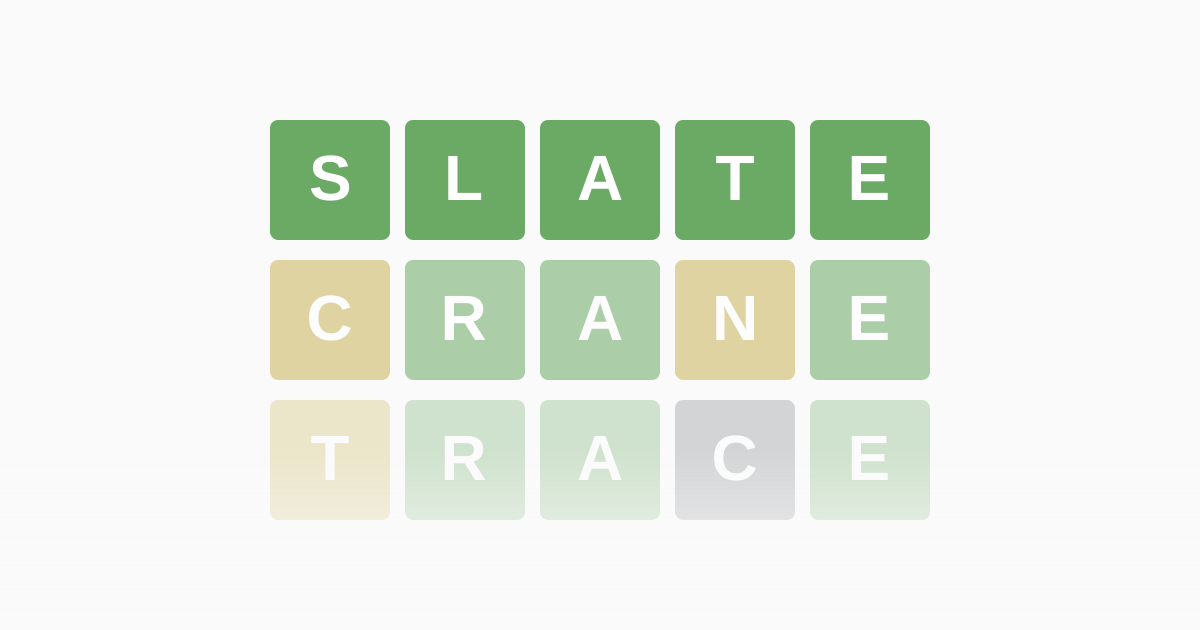
Which Wordle opener should you actually use? Compare SLATE, CRANE, SALET, and seven other choices using answer-list letter data.
Table of Contents
Why Your First Guess Matters More Than You Think
Most opening guesses will not uncover the answer, and that is fine. Their useful job is to test the board. A good opener tells you something about several common letters at once; a poor one can leave hundreds of answers looking equally plausible.
The answer list explains why the familiar recommendations keep appearing. E occurs in about 46% of possible answers, followed by A at 39%, R at 34%, and O and T at roughly 29% each. S, L, I, N, and C are close behind. Put five of those letters into one ordinary word and even an all-grey result removes a meaningful chunk of the dictionary.
Position matters as well as presence. S is especially common at the beginning, while E appears often at the end. A turns up frequently in the middle. This does not mean a green tile is guaranteed; it means the guess is testing places where those letters have historically been useful. The Wordle Strategy Guide explains what to do with the result on rows two and three.
Top 10 Wordle Starting Words, Ranked
The numbers below estimate how many possible answers remain after each opener. Treat them as a comparison, not a promise: the tiles you receive on a particular day matter more than a small difference between two averages.
SALET (~71 average candidates left)
SALET tests five excellent letters, but it is an obscure word for a medieval helmet. It wins some computer rankings; many human players understandably prefer an opener they would use in conversation.
SLATE (~78 left)
SLATE uses exactly the same letters in a familiar arrangement. The modest statistical cost buys a word that is easy to remember, which is why this is our practical first choice.
CRANE (~82 left)
CRANE swaps S, L, and T for C, R, and N. It gives up very little coverage and has been a popular recommendation since an early New York Times analysis highlighted it.
TRACE (~84 left)
TRACE overlaps heavily with CRANE, but moving the letters changes the positional clues. It is useful if you prefer T to N or simply find the word easier to recall.
CRATE (~86 left)
CRATE is TRACE rearranged with E at the end, one of E's strongest positions. The difference between these two is small enough that personal preference is a sensible tiebreaker.
STARE (~88 left)
STARE puts S first and E last. Both placements are common in the answer list, and the word still covers A, T, and R.
RAISE (~91 left)
RAISE checks three vowels without abandoning consonant coverage. Choose it when you want an early picture of the vowels but do not want to go as far as ADIEU.
AROSE (~93 left)
AROSE offers a similar three-vowel balance with O instead of I. A consonant-rich second guess pairs well with it when the first row reveals little.
ADIEU (~110 left)
ADIEU answers the vowel question quickly, yet U is uncommon and the guess tests only one consonant. It is more useful as part of a planned pair than as a stand-alone information leader.
ROATE (~85 left)
ROATE performs well on paper and means to learn by repetition. Its obscurity is the obvious drawback. If using it feels like gaming the dictionary, pick CRATE or SLATE instead.
Best Starting Words by Strategy Type
Not all openers serve the same purpose, and picking one depends on how you like to play.
Vowel-heavy openers like ADIEU (four vowels) and RAISE (three vowels) are built to answer one question fast: which vowels are in today's word? The downside is that you get almost no consonant data, which means your second guess has to do heavy lifting to compensate.
Consonant-heavy words like BLAST, CLUMP, or STERN go the other direction, testing four consonants and a single vowel. They rarely work well as a first guess on their own, but they make excellent second guesses after a vowel-heavy opener.
Balanced openers, two vowels and three consonants, perform best as standalone first guesses. SLATE, CRANE, TRACE, CRATE, and STARE all follow this pattern, generating useful feedback about both vowels and consonants at the same time. Most competitive players and algorithmic solvers favor this balanced approach, and it is the style recommended throughout the Wordle Strategy Guide.
What Makes a Great Starting Word
Four properties separate great starters from mediocre ones.
The first is high-frequency letters. The ten most common letters in Wordle answers are E, A, R, O, T, S, L, I, N, and C. A strong opener includes at least four of them, because every one of those letters appears in such a large portion of the answer list that the feedback you get is almost guaranteed to be useful.
The second is five unique letters. Words with repeated letters, like SPEED or LEVEL, waste a diagnostic slot by testing the same letter twice. On guess one, you want every position pulling its weight.
Third, a two-vowel, three-consonant balance hits the sweet spot for standalone openers. You get enough vowel data to identify placement and enough consonant data to start narrowing the field.
Finally, positional accuracy gives you an extra edge. Placing S in position 1 and E in position 5, where each appears most often, means your green and yellow feedback is more informative than if those letters sat in low-probability slots.
Two-Word Opening Combinations
Some players go a step further and use a fixed pair of opening guesses to test ten unique letters before making any targeted attempts.
SLATE + CORGI covers S, L, A, T, E, C, O, R, G, I, giving you four vowels and six consonants across two guesses.
CRANE + LOUDS tests C, R, A, N, E, L, O, U, D, S with a different letter spread but similar coverage.
ADIEU + STORY is the most thorough vowel pairing, covering all five standard vowels plus five consonants.
The tradeoff with any fixed pair is that you ignore your first-guess feedback entirely. If your opener produces three green tiles, a predetermined second guess wastes a chance to solve on attempt two. For that reason, most experienced players keep their second guess adaptive, using the first-guess results to guide it. If you are still getting comfortable with the basics, the How to Play Wordle guide covers the rules and color system.
Words to Avoid as Starters
Some letters almost never appear in Wordle answers, and building a starter around them is a waste of your most valuable guess. Z shows up in 1.5% of answers, X in 1.5%, Q in 1.3%, J in 1.1%, and V in 3.5%. Words like JAZZY, QUEUE, or FUZZY are testing letters that are almost certainly absent from today's answer.
Repeated letters are another trap. SPEED looks like a good word on the surface since it contains two common letters, but it only tests four unique characters. LLAMA tests three. On guess one, every slot should introduce a different letter.
Proper nouns, abbreviations, and slang are not valid Wordle guesses, so they are off the table regardless.
Hard Mode Considerations
Wordle's hard mode requires every subsequent guess to include all confirmed letters, green locked in position and yellow somewhere in the word. This makes the first guess even more consequential because exploratory guesses are no longer available as a safety net.
The best hard mode starters are the same balanced openers: SLATE, CRANE, TRACE, and STARE. Vowel-heavy words like ADIEU become riskier here. Confirming multiple vowels without consonant context can leave you cycling through dozens of arrangements that all fit the same template.
Watch out for common patterns that generate many valid answers. If your opener reveals _A_E, you could be looking at BAKE, BARE, BASE, CAGE, CAME, CARE, and many more. In hard mode, you must guess from within that template, which can burn through attempts fast when the distinguishing letters are uncommon consonants.
Frequently Asked Questions
SALET ranks as the most efficient opener in algorithmic solvers, narrowing the answer pool to roughly 71 candidates on average. For a recognizable alternative, SLATE uses the same five letters and performs nearly as well.
Using the same word every day builds pattern recognition, since you learn what different feedback combinations mean for that specific opener. Most competitive players stick with one word, usually SLATE, CRANE, or TRACE, and get faster over time because the second-guess decision becomes more intuitive.
ADIEU is the strongest vowel-diagnostic opener in the game, testing four vowels in a single guess. The tradeoff is that it provides almost no consonant data, so it works best when paired with a consonant-heavy follow-up like STORY or CLUMP on guess two.
A strong starter typically shares two to three letters with the answer, but the goal is maximum feedback rather than a first-guess solve. Even zero matches is useful because it eliminates five common letters from consideration.
It matters more than in normal mode. Hard mode requires you to reuse all confirmed letters, so a poor first guess can lock you into a pattern where many valid words fit the same template. Balanced openers like SLATE and CRANE are the safest bets.
SLATE followed by CORGI covers ten unique letters across four vowels and six consonants. ADIEU followed by STORY tests all five standard vowels plus five consonants, making it the best pairing for vowel identification specifically.
Keep Reading
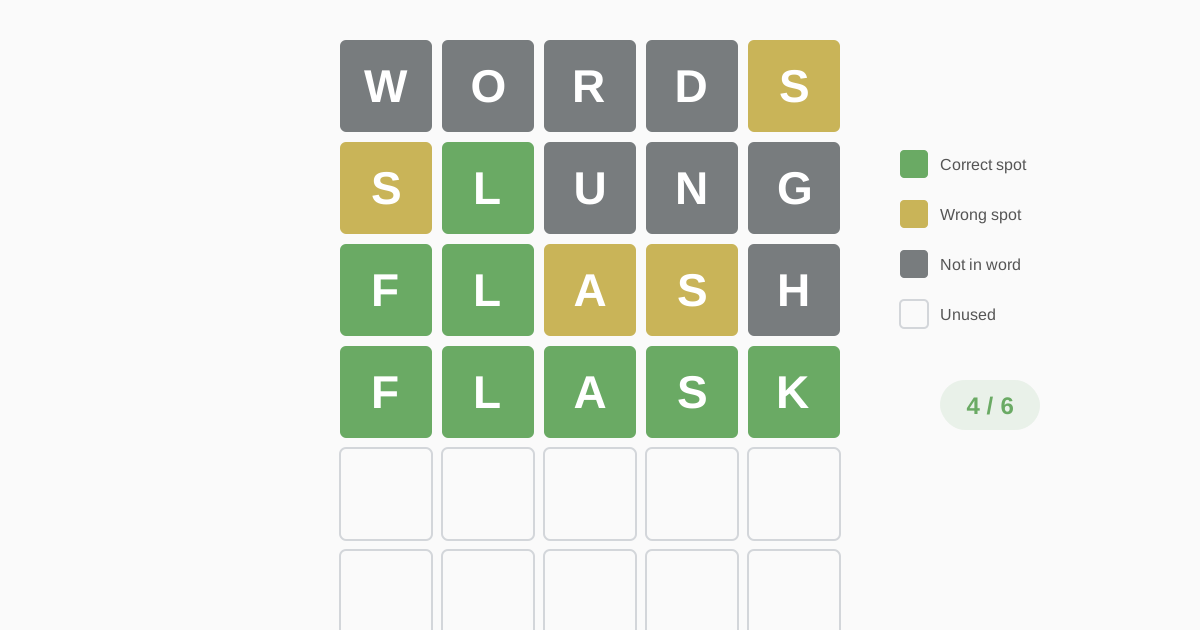
How to Play Wordle: Rules, Colors, and Tips for Beginners
New to Wordle? Learn the six-guess rule, what green, yellow, and grey tiles mean, and how to use each row without wasting letters.
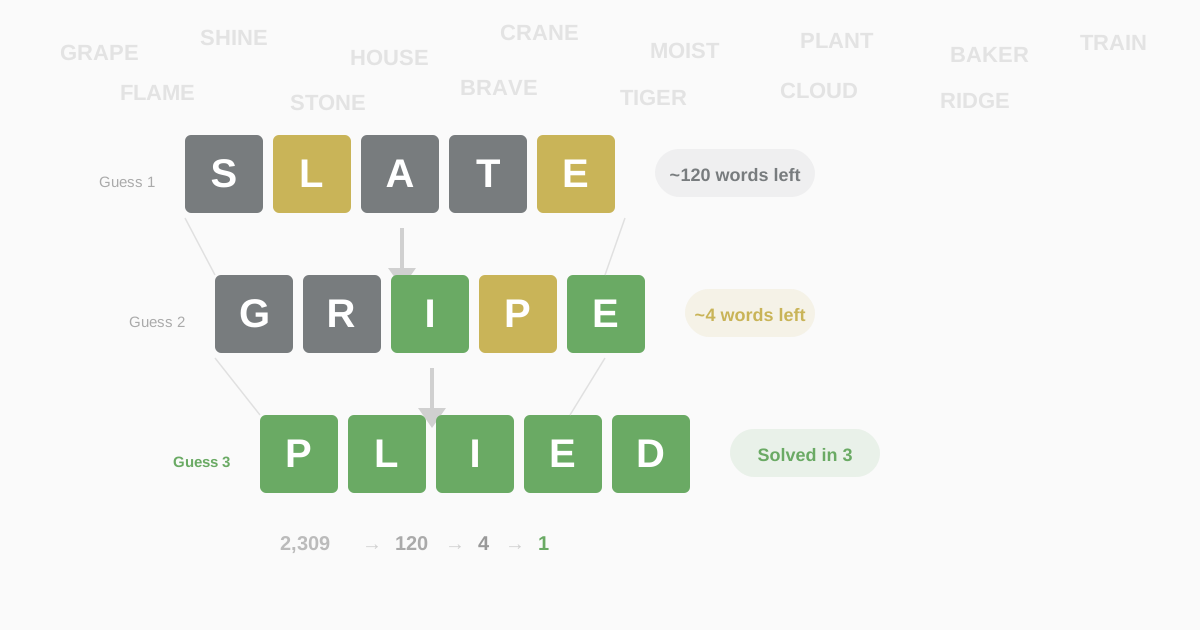
Wordle Strategy Guide: How to Solve in 3 to 4 Guesses
A practical Wordle strategy for using each tile, spotting repeated letters, avoiding word-family traps, and solving more often in three or four guesses.
Need today's Wordle hints?
Six progressive clues, the full answer, and difficulty analysis.
Today's Wordle Hints